Architecture in France
France has more UNESCO World Heritage Sites than almost any other country. Its built environment spans Gothic cathedrals funded by medieval bishops, the grandiose Baroque palaces of the Sun King, Baron Haussmann's unified 19th-century renovation of Paris — with uniform five- and six-storey facades, mansard roofs, and iron balconies — and a tradition of ambitious state-commissioned modernism, from the Centre Pompidou to the Louvre Pyramid and the Millau Viaduct. French Gothic, which emerged from the Île-de-France region in the 12th century, was the style that spread across Europe and gave the world pointed arches, flying buttresses, and vast stained-glass windows. No other country has used architecture so consistently as an instrument of national prestige, from the absolutism of Louis XIV to the Grands Travaux of the Mitterrand era. France also nurtured Le Corbusier through much of his career, producing some of the most debated buildings in 20th-century modernism on French soil.
Notable Buildings
-
French Gothic
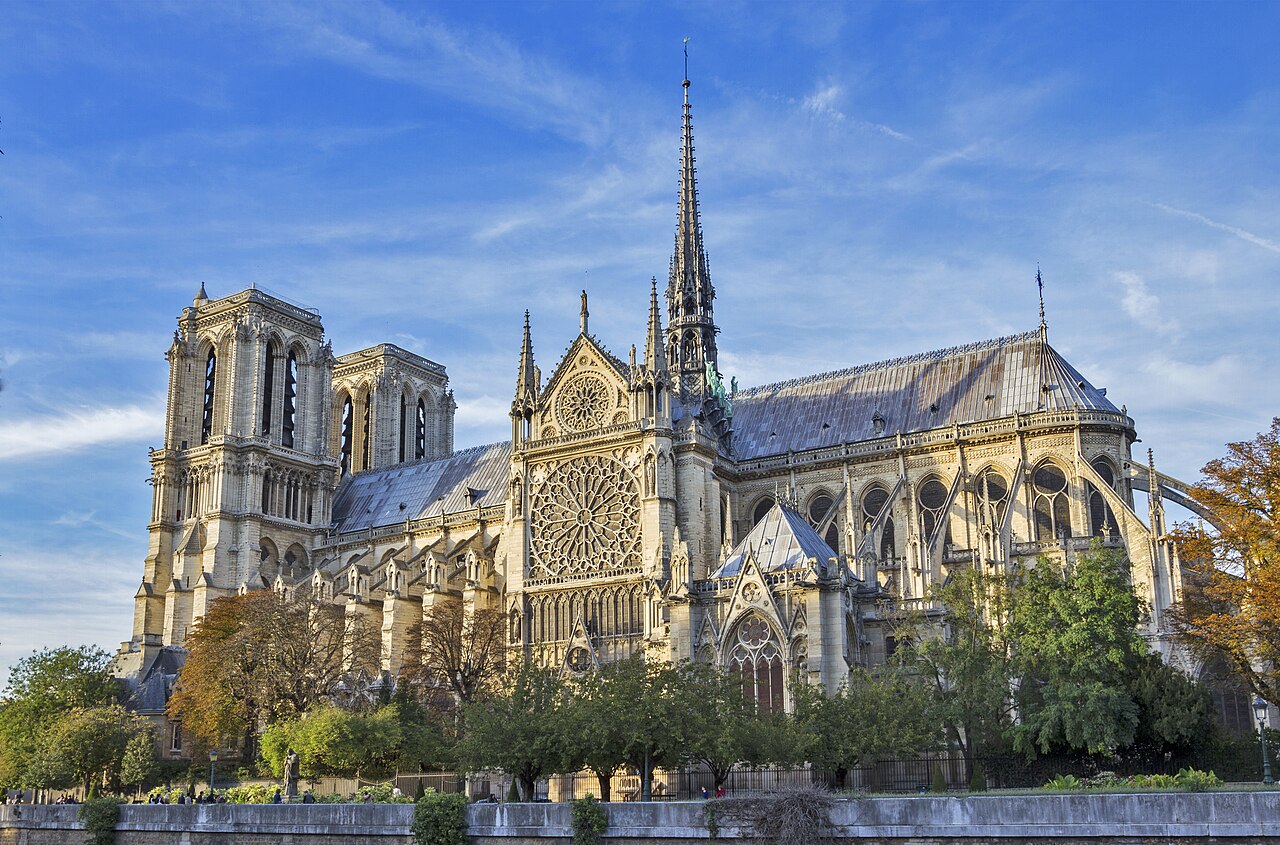
The cathedral that defined High Gothic — flying buttresses, rose windows, two square towers, and a spire rebuilt after the 2019 fire. Construction ran from 1163 to the 14th century, with every major advance in Gothic structural engineering visible in its successive bays.
-
French Gothic
The most complete Gothic cathedral in France, rising above the wheat plains of the Beauce. Its 176 stained-glass windows are the best-preserved medieval glass in the world. Two mismatched spires — one Romanesque, one Flamboyant Gothic — mark different building campaigns separated by three centuries.
-
French Baroque
Louis XIV's monument to absolute royal power. The Hall of Mirrors, Le Nôtre's formal gardens, and fountains designed to awe visiting ambassadors made it the template for European royal residences for a century. At its peak the palace housed over 20,000 people, from the royal family to the lowest servant.
-
Romanesque / Gothic
A tidal island off Normandy crowned by a Benedictine abbey. Tides of up to 14 metres isolate it twice daily; the medieval village at its base was a strategic fortress held against the English throughout the Hundred Years War. The silhouette — island, village, abbey, spire — is one of the most dramatic in France.
-
Structural Iron
Built by Gustave Eiffel for the 1889 World's Fair and originally intended for demolition, the 300-metre wrought-iron lattice structure became the symbol of Paris and held the world height record for 41 years. Critics called it the "iron lady" disparagingly; within a generation it was the most recognisable structure on earth.
-
High-Tech
Centre Pompidou
Renzo Piano and Richard Rogers turned the building inside out — structural steel, colour-coded service pipes, and escalator tubes all exposed on the exterior, freeing the interior for unobstructed gallery space. When it opened in 1977 it was either celebrated as a masterpiece or condemned as a refinery; it now receives over six million visitors per year.
-
Modernist
Louvre Pyramid
I.M. Pei's glass-and-steel pyramid (1989) created a new entrance to the world's most visited museum, its 21-metre height and geometric precision in deliberate contrast with the surrounding Baroque wings. President Mitterrand commissioned it over the objections of much of the French architectural establishment.
-
Neoclassical
Arc de Triomphe
Commissioned by Napoleon to honour his armies and completed in 1836 — long after his defeat. The arch stands at the centre of twelve radiating avenues; twelve names of victories and 558 names of generals are engraved on its inner and outer surfaces. The Tomb of the Unknown Soldier has burned beneath it since 1921.
Architectural Character
French architecture is defined by three great organizing forces. The Gothic impulse — vertical, luminous, structurally ambitious — produced the greatest concentration of Gothic cathedrals anywhere in Europe between the 12th and 16th centuries. The region around Paris, the Île-de-France, was where Gothic was invented and where it was most intensively developed: Chartres, Reims, Amiens, Beauvais, and Notre-Dame are all within a day's travel of each other, forming a circuit of innovation that had no equivalent elsewhere.
The Classical tradition, revived under François I and codified under Louis XIV, gave France the Baroque palace, the formal garden, and the grammar of public architecture that defined European capitals for two centuries. Versailles set the standard not only for palace design but for the relationship between buildings, gardens, and political power — the idea that architecture could be an instrument of statecraft. That impulse has never entirely left French political culture.
The third force is the state itself: France has consistently used architecture as a vehicle of national prestige and political vision, from the Louvre's expansion under successive regimes to the Grands Travaux of the 1980s and 1990s — the Opéra Bastille, the Grande Arche de la Défense, the Bibliothèque nationale de France, and the Louvre Pyramid, all commissioned by President Mitterrand. Contemporary France also has a serious tradition of engineering-led structures, from Gustave Eiffel's tower to Norman Foster's Millau Viaduct, the world's tallest road bridge.
Test your knowledge of European landmarks in the game.
Play Building Guessr